
School Pool, Real Risk
A look at how Hangzhou International School is setting the standard in aquatic safety
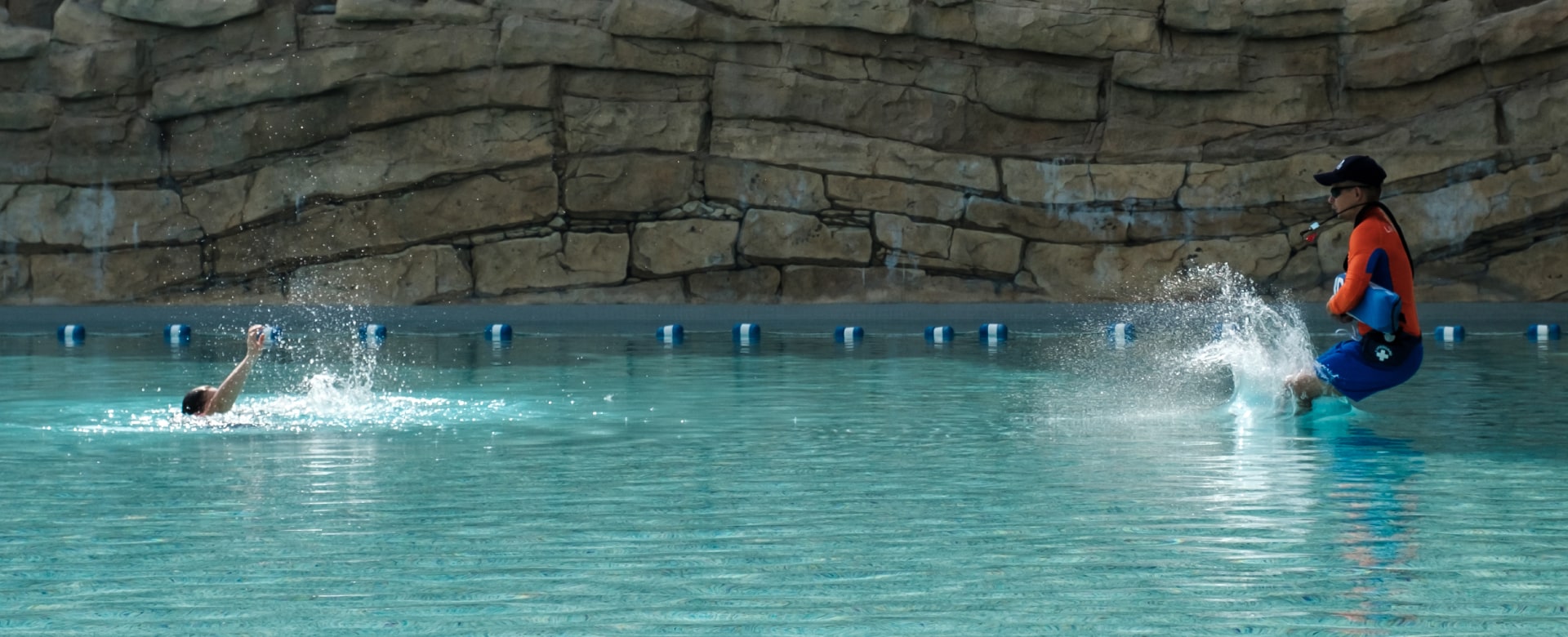
In international schools, the swimming pool is often regarded as one of the most controlled environments on campus. Supervision ratios are defined, staff are trained, programmes are structured with access controlled doors. From the outside, it is a setting that appears absolutely managed. Yet the reality of aquatic risk is less about visibility, and more about timing.
Research from organisations such as the Centers for Disease Control and Prevention highlights that drowning can occur in as little as 20–60 seconds, often without obvious distress signals. In many documented cases, incidents happen quickly, quietly and within close proximity to supervision.
For schools, the implication is not one of alarm, but of perspective: presence alone is not protection: effective response is. Even in highly regulated environments such as supervised swimming pools, drowning risk is not eliminated. 88% of drownings occur in the presence of at least one adult and the CDC also note that most drownings for children aged 1-4 occur in swimming pools. A stark reminder of this reality came from a recent Egyptian national youth swimming championship, where regrettably a 12-year-old athlete died after a lapse in in-pool monitoring during competition.
At SST, this is a dynamic we see consistently across international school environments. Most programmes are well constructed. Staff are qualified, procedures are in place, expectations are clear. The challenge lies in how consistently those systems translate into confident, coordinated action under pressure.
It is a distinction that resonates strongly with Natalio IV Liares, Aquatics Coordinator at Hangzhou International School; a valued partner whose experience spans nearly two decades across the Philippines, Saudi Arabia, the UAE and China.

“It’s not usually about whether people are trained,” Natalio shared with us. “It’s about whether they feel ready to respond when something actually happens.”
This gap between training and readiness is rarely visible in routine operations. It emerges in moments that are, by nature, unpredictable and shaped by timing, environment or human response. Further analysis of aquatic incidents has shown that many drowning events occur despite some level of supervision being present. Contributing factors often include delayed recognition, hesitation, or uncertainty in initial response.
In schools, that complexity is amplified. Teams evolve. Staff arrive with differing levels of experience. Operational rhythms shift across terms, activities and age groups. Within this context, maintaining consistent response capability is less about initial training, and more about reinforcement over time.
Working in partnership with Natalio and his team, this understanding has shaped a shared approach.

From his first school expereince in 2008, Nat’s focus was not on introducing new layers, but on strengthening the connection between what staff know and ensuring a consistent response when under pressure.
“You qualify, you pass, and then you move on,” Natalio noted. “And in a busy school setting, it’s natural for those skills to sit in the background unless you keep bringing them forward.”
From an SST perspective, we believe that structured reinforcement is where this meaningful progress occurs. Powered by Ellis and Associates, Inc., our scenario-based training, regular in-service engagement and clearly defined operational frameworks provide teams with repeated exposure to the types of situations they may encounter.

Over time, this repetition builds familiarity. Familiarity builds confidence. Confidence, in turn, supports clearer decision-making.
“What works well is the relevance,” Natalio added. “It’s not just going through content, it’s putting people into situations they can actually picture themselves in.”
Consistency across teams is another defining factor. In international schools, maintaining alignment is a persistent challenge. Without a shared framework, response can become dependent on individual interpretation, which introduces variability at the point where consistency matters most. At Hangzhou International School, this extends beyond just teaching staff, into the community as well.
“Having that consistency makes a big difference,” Natalio explained. “Especially when you’re working with teams that are constantly evolving.”
At the same time, consistency must be balanced with adaptability. No two school environments are identical, and effective systems must be able to accommodate local context without diluting core standards. Nat proactively works to establish greater confidence in emergency scenarios and clearer communication between staff. And, perhaps most significantly, a shift in how aquatic safety is perceived: from a discrete requirement to an embedded aspect of daily operations.
For SST, partnerships like this reinforce a central principle: that certification establishes a baseline. It does not, in itself, ensure readiness. Readiness is built through repetition, shared understanding and exposure to realistic conditions – all of which must be sustained over time.

“Safety is built through systems, but it’s sustained through people,” Natalio says.“The key is making sure those systems are something your team actually lives with, not just something they complete.”
For most schools, the foundations are already in place. The opportunity lies in how those foundations are reinforced: how often they are revisited, how clearly they are understood and how confidently they are applied.

Because in a school pool, the environment may appear controlled.
But the conditions that define safety are always dynamic.
And readiness, ultimately, is what bridges that gap.
Thank you to Nat and the team at Hangzhou International School for their commitment to aquatic safety. If you’d like to find out more about becoming a partner of SST, please fill out a contact form, visit our website or drop us a DM!